Should cancer in advanced stage IV be treated by conventional treatment procedures?

The word ‘cancer’ is horrific. And, to hear it from a family or general physician that “You have a cancer” or “Your loved one has a cancer”, is like a bullet piercing your heart. You feel as if a bolt of lightning has hit you to the ground and the darkness has fallen all around you. With your body shaking like a leaf, you nervously inundate the physician with questions in a quivering voice, “What type of cancer is it? Where in the body it is located? Could it be treated or cured? Is it going to cut short the victim’s life? and on and on.” The physician may not be able to answer all questions to your satisfaction and so, may advise you to further consult an oncologist for the treatment of cancer.

There are more than 100 types of cancer, each with its unique issues and treatments. The most popular are breast cancer for women, prostate cancer for men, and back, lungs, colon, and brain cancer for both men and women. Like each cancer is unique, so are its victim’s (i.e., a person diagnosed with cancer) physical, immunological, and genetic characteristics. In other words, there is quite a diversity among cancer victims ranging from the nature, type, and location of cancer to their personal physical and non-physical attributes – all affecting the duration of survival after this dire diagnosis.

Unfortunately, the main conventional treatments to cure cancer (i.e., to stop or slow its growth or spread over other organs of a victim’s body) are not that diverse but are just restricted to three – not only in Canada but the world over. These are the surgery, radiation, and chemotherapy (not necessarily in any order of merit). This article briefly touches on these three conventional treatments, even though oncologists occasionally use other treatments including immune cell therapy, and stem cell transplants, to treat some special types of cancer.

How advanced or at what stage a cancer is and its complexity is usually determined by examining microscopically a sample of body tissue with or around the growing tumour, or a biopsy test (in medical terms). The biopsy test determines, first, if the tumour is benign (i.e., non-cancerous), or malignant (i.e., cancerous), and second, the stage it is at.

Five stages of cancer can be detected: early detection (stage 0), its early formation on a body part (stage I), its early advancement on the infected part (stage II), its late advancement on the infected part (stage III), and its widespread not only over the infected part but also on other parts of the body (stage IV). The cancer detected at stage IV usually is in a very advanced stage and most likely has metastasized, i.e., has invaded other organs of a victim’s body. A cancer victim at this stage has very little chance of recovery by any of the conventional cancer treatments. A victim’s life span is cut short as his/her death is imminent over a limited duration of time. An oncologist can easily predict an estimated time of a cancer victim’s survival, based on research and clinical studies.

Knowing fully well that a person with cancer at stage IV has almost no chance of recovery, oncologists in Canada and elsewhere still treat their cancer patients with conventional procedures including surgery, radiation, and chemotherapy. The latter two can be given at separate intervals or at the same time as the clinical studies have shown that radiation and chemo procedures given together are more effective to cure a cancer than given one procedure at a time. The surgical procedure may be applied before or after the other two treatments.

Surgery

This is the quickest way to treat a cancer. If it is at a stage from I to IV, visible and accessible, the surgical procedure can fully or partly remove the cancerous tumour and give the victim an extended life almost free of cancer. For instance, a woman with cancer in one or both of her breasts can lead a cancer-free life after having her breast(s) surgically removed (i.e., mastectomies), or a cancer in the toe or foot or lower leg can be surgically removed for highly diabetic men and women. On the other hand, if cancer is in an inner part of a victim’s body, like the head or brain, a surgeon can scrape it, if unable to fully remove it, to enhance a victim’s length and quality of life.

Unfortunately, the surgical procedure carries several risks including a post-surgical infection, bleeding, pain, disability, or disfigurement after removal of any body part. And, if a scrapping of say, a brain tumour is done, then there is a risk a victim could suffer paralysis, stroke, loss of memory, speech, comprehension, etc., if a surgeon scrapped not only the tumour but also other healthy tissues of the normally functioning brain. A surgical procedure in this case of over-scrapping of a brain tumour would destroy a victim’s quality of life, making him/her physically dependent on others. A victim still lives with a left-over tumour, which in turn, would likely grow over time.

A surgeon can, however, avoid hurting a patient by such an over-scrapping of tissues if he/she could use more sensitive and technical instruments that would identify cancerous and healthy tissues. As of now, a surgeon simply uses MRI images to conduct brain surgery including scrapping. And, since these images don’t mark a separation between cancerous and healthy tissues, the surgeon is most likely to err and scrape the healthy tissues, thus damaging the quality of life of a patient.

The bottom line is that surgical procedure carries very serious side effects. There is no guarantee that it would cure a victim’s cancer (except for removable body parts); it may even cause a victim more serious physical injury and damage, with a part of the tumour still present.

Radiation

The radiation procedure is meant to cure or shrink the size of the tumour by applying intense heat from outside the body over many short sessions – a number that is estimated by an oncologist, given a victim’s type of cancer, the stage it’s at, its rate of progressivity, age, sex, weight, and any other morbidities present. Even though this intense heat is pinpointed on or close to the location of the tumour, the chances are that the heat would also burn or damage the body’s healthier tissues around the tumour being burned.

Oncologists try to minimize this problem of damaging healthy tissues by providing a victim with a customized protective shield to cover the area(s) around the tumour to be burned. Unfortunately, such a shield is not 100% effective. The risk of damaging healthy tissue(s) around the tumour by the intense heat remains.

Other major side effects of radiation include nausea, vomiting, and tiredness. Even though an oncologist prescribes a victim an anti-nausea and vomit-control medicine like Gravol before the radiation procedure, a victim is still likely to vomit and have dizzy spells, besides other effects, depending on a victim’s physical and non-physical characteristics, besides the size and location of the tumour.

Chemotherapy

Unlike the surgical and radiation procedures, which focus on the location of a tumour, the chemotherapy procedure to treat cancer affects the entire bloodstream of a victim. Under this procedure, an oncologist prescribes a victim one or some combination of toxic medicines either in the form of pills or capsules to be taken by mouth or injections over a recommended length of time like five or twenty-eight consecutive days, as deemed necessary by an oncologist. The dose and daily intake of medicine(s) are again determined by an oncologist, depending on the nature and complexity of a victim’s tumour.

This is the worst of the three conventional procedures as the intake of toxic medicines makes the victim’s bloodstream highly toxic, which in turn, may deaccelerate the growth of a tumour or shrink its size. This procedure generating toxicity, however, is also likely to damage the functioning of other vital organs of the victim’s body, namely, the liver, kidneys, lungs, and heart’s arteries. Once the toxicity affects one or more of these key organs, a victim becomes more bedridden as he/she feels completely worn out – too tired to walk, sit, or remain fully awake. A victim also loses control of body muscles that control peeing or passing of stool.

The longer a victim is on chemotherapy, the more likely he/she is going to live a fully dependent life on caregivers, and eventually live like a breathing-dead. The toxicity caused by chemo drugs may kill some cancer cells or slow the growth of a tumour, but the reality is that it may cause a slow death to a cancer victim. A victim with stage IV cancer already has limited odds of long-term survival. Too much toxicity caused by the ingestion of chemo drugs further shortens a victim’s remaining life span.

Besides making the bloodstream toxic, the chemotherapy has other side effects as well. These include fatigue, loss of appetite, nausea, vomiting, and loss of hair – to name a few. The major risk of ingesting a chemo drug is that it can be fatal if it turns out to be incompatible with any of the DNA cells of a victim. A victim can die right after ingesting the first dose of the drug. Even though the health professionals do check the compatibility between the prescribed chemo drug and the key cells of a victim’s DNA before letting a victim take it, it’s unfortunate that incompatibility with any of the non-pre-tested DNA cells would result in a fatality.

Consent for a procedure

In Canada, healthcare professionals, including doctors, surgeons, and oncologists, can only recommend, encourage, or persuade a patient, including a victim with stage IV cancer, to undergo a given treatment or procedure if it carries any risk or adverse effect for a patient. A patient must voluntarily sign a consent form before having any such procedure with a clear understanding that he/she fully understands the risks and side effects of the proposed procedure as explained by a health professional. A patient must provide a signed consent form for each recommended procedure. Doctors and oncologists also need the patient’s consent to save their skin so that they are not to be blamed or legally sued if the patient were to suffer a post-procedure physical or brain injury, including paralysis, stroke, or death.

Indeed, when surgeons and oncologists are faced with a victim of stage IV cancer and have the victim’s written consent, they would apply the procedure even if they knew in their hearts that the chances of treating and curing cancer at this advanced stage were remote. They would proceed as they are supposed to on purely professional and ethical grounds.

On the other hand, a victim with advanced cancer still has the option to accept or refuse the proposed treatment procedure. Very rarely one would find a cancer victim refusing to undergo any of the treatment procedures because almost all cancer victims would strongly wish to have an extended life – the underlying reason for voluntarily consenting to undergo the recommended procedure.

It’s saddening that victims don’t know the reality of what their treatment providers do. What usually happens under these circumstances is that the providers of treatment would keep rhyming periodically to both their patient and his/her family members that the procedures have been ineffective, i.e., not working to cure the growth of cancer – something very disheartening and heart-wrenching for family members to keep hearing. Such post-treatment conclusion is generally reached after periodic examinations of a victim’s MRI images.

Conclusion

I would conclude that doctors, surgeons, and oncologists should refrain from treating a patient with stage IV cancer with conventional treatment procedures like radiation and chemo. Surgery (including scrapping), on the other hand, is not a panacea either, it can, however, still be used to treat stage IV cancer and help extend marginally a victim’s life span. Canadian oncologists must find a better alternative to treat a victim of stage IV cancer, like a customized treatment procedure, be it a stem cell transplant, immuno-cell replacement, or else. Such customized treatments may be costly but are worth every penny to save thousands of human lives.

Keywords: Cancer   Surgery   Craniotomy   Radiation   Chemotherapy   Stem Cell  Immune Cell

Our Messed Up Hospital Care: A Personal Account

We are aware how the paramedics, our first line of rescue from accidents or medical emergencies, rush the sick and/or injured to hospitals. Once in, they line up patients, most hooked up with monitors, on the stretchers against the walls of corridors of hospitals and run to the nurses’ station to announce a patient’s arrival and complete the required paperwork. The paramedics wait until they complete the handover of a patient to a nurse. That completes their work.

Those who go to an emergency department on their own, or brought in by friends or family members have to wait for hours in the waiting room except those suffering a heart attack, stroke, or an open bleeding wound. These persons have to wait for hours and hours before they get checked initially by a nurse, then by a medical professional – likely a doctor on duty (mostly an intern). After the initial diagnosis, a person either goes home with or without a prescription or kept for further observation; if latter, the nurse or doctor instructs that person to lie on a stretcher in the emergency ward.

The next phase which is critical includes care, medical attention, and the treatment needed for a patient brought in or registered for admission for observation and/or treatment in the emergency ward. And that’s where lies the problem.

Patients, with or without hooked monitors, have to wait for hours and hours, lying on the stretchers placed against walls of corridors, hoping a doctor would soon check them and prescribe the required remedy. While they are waiting, nurses check their vital signs including the blood pressure, body temperature, pulse rate or heartbeat per minute, and body’s oxygen intake. And if they are in a severe pain, nurses may offer them just a regular Tylenol or some other light or standard painkiller as they can’t give any stronger medication until a doctor has examined and prescribed it. We commonly call this kind of care as the “Hallway Treatment.” Patients can remain on stretchers in the hallways for hours or even days – depending on how full the hospital’s emergency ward is, how many doctors are on the floor and how busy they are, how critical a patient or his/her injury is, etc. And if that patient requires a blood test, then the time to get the results further adds to the waiting time. That patient may also remain in the emergency ward if there is no room available in any other ward of the hospital.

Seeing or experiencing is believing. Even though I had read and watched all about this kind of hallway care in the newspapers and on television news, I hadn’t experienced this “waiting in a hallway situation” until the evening of February 11, 2020 – the day I slipped like a rolling ball on a patch of black ice while picking up a meal from someone’s home in Orleans around 7.30 p.m.

As I slid and fell hard on the icy walkway, hitting mostly the top of my back and softly the back of my head, I couldn’t get up at all. With back hit hard, I felt the reflexive pain in my upper chest and its cavity. I believe I lost consciousness for a moment. As I lay down on the icy surface, my first thought was what if I had hurt or broken any of my patched arteries, usually left after an open-heart surgery, and the four stents implanted in my arteries around the heart? Since I couldn’t lift my body up, and I too didn’t want to move because of the fear of causing any more damage to my heart, I kept lying on the icy surface and wanted the paramedics to come and help me. Thank goodness, I was wearing a thick waterproof winter jacket, covering a part of my bums, that saved any freezing of my back. My cotton pants were getting soaking wet, though.

Luckily, I had my cell phone with me attached to my belt around the waist and could access it. I opened it up and pressed the number of the resident who had closed the door right after I had picked up the bag containing meal and asked him to come out quickly and call the paramedics. He came out in a panic and didn’t really know what to do or how to handle the situation. I again instructed him to call the paramedics. I gave him my phone to dial 911 and insisted upon him to call for medical help.

While I was lying on the icy, snow covered walkway of his home, he called 911. In the meantime, his mother came out and wanted him to lift me up and take me inside the home. She worried that lying on a sheet of snow would worsen my pain and/or injury. I told her and her son not to move me. I desperately wanted the medical help.

While he was on the phone, he had to answer the 911-receptionist why the number associated with the phone he was using didn’t match the address the help was being called at. When he told the receptionist that the phone belonged to the injured person who was just picking up the food from his home, and had fallen, she asked him how old I was. He paused and repeated the receptionist’s question. I told him I was seventy-eight-and-a- half years old. The receptionist told him the paramedics and ambulance would be there in a few minutes.

Since I could see the road from the spot I was lying, I was so relieved to see the paramedics’ car stopping in front of the house within 5-6 minutes. Two paramedics came out of the car, one carrying his medical kit along with the standard full gear.

The one who was carrying the box, placed his box on the icy surface and began checking on me. He asked me preliminary questions like how did I fall, where exactly I fell, where was I hurt most, was my head bleeding or swelled, did I feel if I had fractured my ribs or damaged my spinal cord, or pelvis, and so on. While he was asking questions and making me talk to stop me falling into any unconsciousness, he ran his open palm at the back of my head, removed my scarf around the neck, and unbuttoned my shirt to run his palm over my chest, touching its cavity, heart area, and top of the shoulders, trying to feel if there was any sign of a lump or fracture or bleeding. He apologized for baring a part of my upper chest in the freezing cold and tried to calm me down by telling me that the ambulance would be here shortly. He would examine me fully inside the ambulance. While he was talking, I could see the ambulance stopping behind the paramedic’s car.

As soon as the ambulance parked, the driver and his co-worker opened the rear doors and pulled out the stretcher. They rolled it up on the driveway, closer to the spot where I was lying, gently lifted me up and put me on the stretcher and covered me with blankets. They rolled me back to the inside of the ambulance. Once inside, the one who was checking on me spoke to the driver. They talked about carrying me either to the Montfort Hospital off Montreal Road or to the Ottawa General off Smyth Road. The guy who had been initially checking me spoke to someone on the phone and got instructions to take me to Montfort.

While we were on the way to the Montfort Hospital, the paramedics took off my winter jacket and scarf, and in the fully lighted area, checked me all over again in the enclosed and warmer environment. He kept talking to me about my pain, its intensity on a scale of 1 to 10, and asked me about my name, address, age, height, weight, ailments I was suffering from, medicines and supplements I was on, and the OHIP card number.

I pulled out the wallet from my left pocket of my pants and gave him my “Medic Alert” card that I always carry with me. He copied all the information from the card to his form, including the OHIP card number. Then he confirmed with me; I was a heart patient, having had open-heart surgery, followed by four stents implanted. Also, I was suffering from hypothyroidism, prostate issue, and had cataract surgery done on both eyes. Then he confirmed all the medicines and supplements I was taking. Finally, he asked me how was my pain. I told him it was excruciating – around 10 on a scale of 1 to 10. He told me not to worry as we would be at the hospital within a few minutes. As he stopped talking, I called my younger daughter, Shelly, who was at some get-together in Rockland, and told her I was calling her while being driven to the Montfort Hospital as I had badly fallen on the icy steps of the house from where I was picking my food up.

As soon as we reached the covered ambulance parking area of the emergency section of the hospital, the guy who now had all the information about me joined the driver and his co-worker. The latter two opened the doors of the ambulance, and brought the stretcher down, placed my jacket and scarf near my feet, still covered by the snow-boots, and rolled me inside the hospital. They placed my stretcher against the left side wall, near the entrance to the hospital. The guy with my information left me and walked away to the nurses’ area to report about my arrival with details about my condition. I looked at the clock on the wall of the corridor. It was 8.12 p.m.

There begins my waiting time, with one eye on the clock. And how did it go?

I could see the clock ticking away as I wait for a check-up by a doctor and the recommended treatment of severe pain in my chest, its cavity, and the rear upper part of back including the shoulder blades. I lay on the stretcher, with one eye on the clock on the wall, ticking seconds into minutes, and minutes into hours, between 8.12 p.m., February 11th, and 7.15 a.m. February 12th. How did the hospital’s emergency staff treated the frail old man with unbearable pains in his chest and the rear upper back is worth noting?

Time and activity:

Tuesday, Feb 11th.

08.12 – 08.30 p.m. A nurse arrived to confirm all the information that she had received from the paramedic. She put an ID white paper band around my left wrist, again verifying that I was there because of severe pains resulting from a hard skid on an icy walkway.

08.30 – 09.30 p.m. My older daughter, Sharon, showed up near my stretcher. She came to see me after her sister, Shelly, informed her about my fall and being in the hospital.

09.30 – 10.00 p.m. An orderly came over, mumbling, “Let’s move you away from the entrance door”, and rolled my stretcher to the main corridor and placed it against the long wall – just next to the side entrance to the big hall, likely the working area of nurses and doctors.

10.00 – 10.30 p.m. My younger daughter, Shelly, arrived. She greeted Sharon and then turned to me, asking what happened and how my pains were. Now both of my daughters were there, concerned about my well-being. Also, I had one nurse temporarily assigned to me as she asked me, “How was I feeling?” from time-to-time.

10.30 – 11.00 p.m. I insisted upon Sharon to go home as she had two kids under 4 years of age at home, likely sleeping in the care of their dad. After she left, I told Shelly as well to go home as both girls had to go to work the next day. She didn’t agree and insisted on staying with me overnight.

While my daughters were there, a nurse came over and gave me a regular Tylenol, telling me, “I may not give you anything else without a doctor’s orders.” She also gave me an injection in the arm with comforting words, “This will reduce some of your pain for sure.”

11.00 – midnight hour. Now that Shelly was with me, pacing, walking, standing against the wall, or sitting on a chair near my bed’s footrest, a man, in a light blue plastic overall and wearing a cap of the same colour, came over to me and asked, “How are you feeling? How are your pains?” “Terrible,” I replied feebly and added, “I want someone to x-ray my back and chest to see I have no fracture or broken my ribs, or damaged my spinal cord or pelvis.” He poohs-poohed my request and told me he would do something better than that – he would order a blood test first. Later a nurse came and drew a blood sample from one of the center veins of my right arm. A little later, another nurse came and took an ECG of my heart.

February 12th:

12.00 – 01.30 a.m. Since I had eaten nothing after my breakfast on Tuesday morning, I was now feeling hungry. I told the nurse who has been occasionally attending me for the last few hours. “What would you like to have?” she asked, ” I can bring you a muffin and an apple juice.” I told her to look for an egg salad sandwich, if she could, as I didn’t want to eat a cold bran muffin. After a few minutes wait, she brought an egg sandwich, one-half of which I ate and the other half I put aside. Around 01.30 a.m., I asked the nurse attending me, “How much longer do I have to wait for some doctor to check on me as I have been lying here for over five hours?” She replied, “Tonight the average wait time is ten hours as there are so many people coming in and there are just three to four doctors working in the emergency ward. You have to wait for another five hours before any doctor could see you.” That meant that someone would check on me by 06.00 a.m. or after at the earliest. I had to suffer from the severe pains, especially in my chest and top of the back. The pain compounded by frustration was really testing my nerves.

01.30 – 02.30 a.m. Just after 02.15 a.m., an orderly came over and softly mumbled, “Let’s move you in the emergency ward where a doctor could check on you.” He moved my stretcher away from the wall and rolled me to the emergency ward. Once he placed my stretcher at the marked area near the wall with all the monitors and equipment on stands, with their wires hooked in black and red power plugs, he drew the blue curtains on both sides of the stretcher and its footrest. Now I was in a make-shift emergency room, aligned in a row of other beds with or without patients. While he was fixing up my stretcher, I could see the clock on the facing wall. It was 02.30 a.m. That meant that after over six hours of waiting, I was finally lying in the emergency ward for a treatment. Now I had to wait for the doctor. I kept lying on the stretcher, whereas Shelly sat on a hard wooden chair placed near my stretcher. We spoke to each other occasionally, closed and forcibly kept open our tired eyes. Naturally, we both were tired, bored, and getting very restless as the wait was draining us completely.

02.30 – 04.00 a.m. Around 3.30 a.m., I heard a lady doctor’s footsteps entering the area of a female patient, lying on the stretcher on my left. She had fallen while descending stairs of her basement and had hurt her knees badly. She was likely brought in to the hospital ahead of me as my stretcher was next to hers in the hallway. She also had been rolled into the ward ahead of me. She too was accompanied by her young daughter; the latter lay on the floor to rest or take cat-naps. I could see her get up when the doctor stood near her mother’s stretcher. I could hear the conversation between the doctor and the patient explaining how she fell off the stairs and how painful and swollen her knees were. She wanted some immediate relief. While they were talking, I was mentally preparing myself to speak to the doctor, presuming I would be the next one to be checked during her current round of the ward. I felt relieved too that I didn’t have to wait for ten hours; rather I would be done in 8 hours. How wrong I was? I heard her walking away after checking and recommending the treatment to my left neighbour. I was quite incensed and distraught over her action. I immediately got up and went to the nurses’ station and asked one nurse, who was walking in the ward, “How come the doctor who was here a moment ago didn’t see me?” Since that nurse was a French speaking, she likely didn’t understand my question and asked me, “What … you want … I am serving someone,” and she left me. I went to the washroom and came back to my stretcher. Now I was getting restless and wanted to leave that damn room.

4.00 – 7.15 a.m. Nothing happened. Even when the clock struck the hour of six, I had a glimmer of hope that some doctor would eventually show up to check on me. I had waited for the full 10 hours as suggested by the nurse. That hour too passed with no doctor in sight. I couldn’t tolerate any longer. Suffering with severe pains, I was running out of my patience and wanted to give someone a genuine piece of my mind. Shelly was equally getting frustrated as the poor girl had been working all day Tuesday and wasn’t able to sleep all night. She looked haggard. She had a work-related meeting at 9 o’clock (i.e., Wednesday, the day she worked from home). We waited till 7.15 a.m. as the shift of doctors and nurses changed at 7.00 a.m. We thought another doctor might show up at the beginning of his/her first round to look after patients left unchecked by the night-duty doctors.

At 7.15 a.m., I got up from the stretcher, placed scarf around my neck, and zipped up my winter jacket. Shelly was all ready to walk out. At 7.20 a.m. Shelly and I walked out of the emergency ward right by the nurses’ station. No one asked us a question about who we were or why we were walking out of the ward. We just walked up to the parking lot and drove to Orleans.

On the way, I kept cursing the doctors, the hospital’s negligence to pay particular attention to the pain, suffering, and ailments of the frail elderly – granted, not at the expense of caring for patients who had been brought in on account of a heart attack, stroke, or any other serious injury/illness requiring immediate attention – as we older folks are the most vulnerable, and unable to bear serious pains for too long. We elderly people need prompt attention, treatment, and care as we no longer have the stamina and energy to suffer severe and lingering pains, especially exacerbated by unnecessarily longer wait times. We ought to be cared at the earliest opportunity. Unfortunately, our current health system is not providing the care and treatment the elderly deserve. Some doctors already treat the elderly as discarded and spendable. And this problem will get even worse over time because of our steadily rising numbers – a demographic reality that our governments, social and health policy makers have to reckon.

Since I was still suffering from the unbearable pains in my upper back and chest, especially its cavity, we decided to drive to the Orleans Urgent Care Walk-in clinic off Place d’ Orleans Boulevard. I desperately wanted a doctor to check me; wanted him/her to take x-rays of my painful areas to ensure that I had broken no ribs or damaged spinal cord or pelvis. I knew I wouldn’t get any appointment with my family doctor that quickly. Seeing a doctor at a Walk-in clinic was the only way to get a prompt treatment.

This clinic opened at 8.00 a.m. Also, this had the facility to take x-rays and conduct other standard tests, if required. We were near this clinic a little before 8 o’clock. So we waited out at the nearby Tim Horton’s. While Shelly had gone to fetch two cups of coffee and a bagel for herself, my cell phone rang. It displayed a call from the Montfort Hospital. A nurse from the emergency ward was on the other end.

She wanted to know where I was as she had gone to check on me in the ward. She had started her shift at 7 a.m. and was going over the list of patients still in the ward, including me. I told her I left the ward at 7.20 a.m. in utter disgust and frustration as no doctor bothered to check on me over 12 hours in the emergency ward. I desperately wanted a doctor to check on me and I thought seeing him/her at a Walk-in clinic was the best option I had. She apologized for what had happened to me, explaining that there was only one doctor on the floor last night. This was contrary to what the nurse attending on me last night told me that there were 3-4 doctors on duty in the ward. I couldn’t believe her explanation that there was only one doctor taking care of patients in the emergency ward. Then she added a typical and commonly used excuse, “You know it was one of those busy nights when a steady flow of patients had swamped the ward,” and on and on. As I was boiling mad inside, I didn’t want to pursue any conversation with her. She was just a nurse working there and had no control on how the system runs. She was just trying to defend her peers and doctors’ negligence and irresponsibility, besides the public reputation of the hospital. I told Shelly the gist of my conversation with the nurse when she got back with her coffee and bagel.

Shelly dropped me at the Walk-in clinic at around 8.40 a.m. The waiting room was already full of patients. I took the number and waited to be called by the receptionist. A little after 9.30 a.m., the receptionist called my number. I walked up to her desk with my OHIP card in my hand (as per clinic’s instructions to patients – as the first thing the receptionist does is to run this card over the online system to claim the charges) and explained her why I was there. I told her I was in severe pains and was coming from the emergency ward of the Montfort Hospital after waiting there for 12 hours. She was sympathetic and instructed me to wait until called in by a nurse.

Around 10.15 a.m. I heard a nurse calling my name. She wanted me to go to Room #1, close the door after entering it, and wait for the doctor. I removed my snow-boots as instructed by the nurse and followed her to the room. After about 15-20 minutes, another nurse came in and took my vital signs including the body temperature, blood pressure, heartbeat, and the level of oxygen intake. She wanted to note all of my major ailments and prescription drugs I was taking (though the clinic’s records contained all such information as I had been visiting this clinic in medical emergencies). While she was working on my vitals and recording other details, I told her I was coming straight from the Montfort Hospital’s emergency ward as no doctor there could check on me after almost a 12-hour wait. She promptly replied, “If you were in a hospital across the river (i.e., in Gatineau, Quebec), you would have waited for 20 hours. You are lucky that you had to wait for 12 hours at Montfort.” She showed her professional empathy to me and told me, “A doctor will see you soon.” She left me alone in the room and closed the door.

No doctor showed up in the room. In the quiet and closed room, I kept looking at the walls, the medical equipment in the room, and all the charts on varied health issues including major ailments and their preventive measures. I read and re-read all the charts to kill time. Since the room was closed to the work-area of doctors, I could hear their conversations, including the ones they had with patients in adjoining rooms in the corridor. I had no clue about who would check on me among the two or three doctors working at the clinic that morning. I overheard one doctor talking to several persons (likely a doctor, nurse, or someone in the administration) at the Montfort about me and how I had left the emergency ward.

Now I could put together the reason no doctor had come over to check on me. Since I had left the hospital’s emergency ward without a proper discharge, I likely was carrying some risk of suffering more physical damage to myself and no doctor outside the hospital’s emergency ward would want to check on me in that situation. Eventually, after more than an hour’s wait in the room, I opened the door and walked up to the doctors’ work-station and asked one, “Is there any problem? I have been waiting for the doctor for more than an hour. This is rather unusual in the Walk-in clinic. How long do I have to wait?” The doctor replied calmly, “You are the next one on the other doctor’s list. He will come see you after he’s done with the patient he’s checking now. I am sorry you had to wait that long.” Quietly, I came back to Room #1 and closed the door.

As the noon-hour struck, a nurse came in and wanted me to move to another room as she needed Room # 1 to examine another patient – since this room had more medical accessories hooked up on the walls than the room I was moving to. After I entered that room and looked around, I was right. I sat there, looked around the mostly empty walls and a few hanging charts on health issues that I had read in the previous room.

At 12.30 p.m., I heard a knock on the door, and lo-and-behold, finally a doctor entered the room. I was just ready to vent out my anger and give a little sermon to him about how to take care of patients, especially when they are in severe pains. But I controlled and acted normally. Since he had all the information about me, including the reason I was there, how I had played truant at Montfort, and my painful body areas. He asked me how I was feeling and about the intensity of pains. I requested him to have some x-rays taken just to ensure that I didn’t suffer any fracture in my ribs or back. He wrote me a requisition slip and directed me to go to the next room for x-rays.

By 1.15 p.m., I was back to see the doctor. Thanks to the technology, he had received all the x-rays of my chest, ribs, lungs, upper back, and the spinal cord. He told me he wasn’t a radiologist, but he could still draw the key conclusions from x-rays. He went over these, one-by-one, with me and told me that there was no sign of any fracture. He informed me that a radiologist would examine these x-rays in the next few days, and if there was anything serious, he would be in touch with me. In the meantime, he wanted me to take a regular Tylenol as a painkiller.

Before leaving him, I couldn’t help asking him, “What took you all that time to examine me? I had to wait for over 2 hours and I don’t think that’s the norm here at this clinic.” He grinned and replied, “Well, waiting for 2 hours here was far better than 12 at the hospital.”

What an attitude? As a doctor, he should have shown some compassion, empathy, and understanding of a patient’s condition. I didn’t think it was worth arguing with him and walked out of the clinic.

It was after 1.30 p.m. that I called Shelly to pick me up and drive me to the place where I had left my van the previous night. I had already called the homeowner and had given him an approximate time about meeting him. He saw Shelly dropping me at his driveway. He came out and gave me the keys, also apologizing for what had happened last night. Since I was in pains, I didn’t want to talk with him any longer. I drove the van to my home, half-bent on the driver’s seat, as I couldn’t sit straight up.

As soon as I reached home, I took a Tylenol #3, a powerful painkiller with codeine. I continued to take it until Friday, February 14th – the day I finally got examined by my family doctor. He recommended me to a much more powerful painkiller containing morphine.

Since I was angry and frustrated over what I had experienced and was still very painful, I tweeted to Ms. Christine Elliott, Ontario’s Minister of Health and to The Ottawa Citizen complaining about the lack of care at the emergency department of the Montfort Hospital and our messed up health care system – especially for the elderly. I am still waiting for her response.

Does anyone care about how we get treated under the current health care system? The bottom line is we are all just numbers in the system.

Tags: Elderly, skidding on ice, emergency ward, wait time, lack of medical care, Montfort Hospital, walk-in clinic, lack of empathy.

Are All Goodies Being Offered by Parties Vying for Power in 2019 Election Make Sense?

Introduction
It’s election time in Canada. Canadians go to the polls on October 21, 2019. All political parties and their leaders vying for power are offering their election manifestos, that is the menu of goodies along with their projected costs to be offered to families, things and tasks that they will do and/or accomplish, if elected to govern. Nothing unusual. Parties and leaders in all democratic countries, developed and undeveloped, follow the same procedure. Canada is no exception. For politicians, the election time is the time to show who can offer voters the best of goods and services with voters’ own money. That’s also considered bribing voters with their own money. 

And what’s the politicians’ source of providing financial help to voters? Money collected by government as direct income and sales taxes from taxpayers, their mandatory and voluntary contributions and deductions on several federal and provincial plans, excise, corporate taxes, and all other indirect taxes – the key sources of government revenue, besides borrowings.

In the upcoming October election, there are six parties vying to form a government: the incumbent Liberals, Conservatives, New Democrats, Green, Bloc Quebecois, and People’s. This blog is not intended to synthesize the manifesto of each of these parties. It’s simply focused on the two specific goodies being offered by the two main contenders, the Liberals and Conservatives: first, offering more income to low and middle income class voters by tweaking the rate of first income tax bracket, giving additional tax credits, or by raising limit of basic income exempted from tax as well as by raising benefits currently provided under Canada Child Benefit  program; and second, offering help to first time home buyers.

Do the stated ways and means of providing help to families in respect to these two commitments make sense and really help voters or are just  gimmicks to get votes? 

Let’s look closely at each. 

Raising incomes of low/middle income voters and their families

The conservatives’ slogan is to put more money in the pockets of low and middle class families and help them move forward. To do it, the Party is proposing to reduce the first income tax bracket from the current 15% (brought down from 17% by the Liberals after the 2015 election) to 13.5% along with tax credit of $1,000 annually for each child for fitness and sports-related activities, $500 for children’s arts and educational activities, another $500 for parents with children with disabilities. Besides these, the Party is offering a transit credit worth 15% that tax filers spend on buying monthly passes for using public transport including buses, streetcars, subways, or local ferries, designed to cut emissions causing air pollution. Most of these credits are being re-introduced from Mr. Stephen Harper’s era , as these were terminated by the incoming Liberals in 2015.

The Liberals, on the other hand, are proposing to increase the amount of basic income exempted from tax from $12,000 to $15,000 for all tax filers. In addition, the Party is proposing to increase Canada Child Benefits by another 15% for children under one year of age as well as benefits under Old Age Security (OAS) program by 10% for persons aged 75 and over.  The Party recognizes that families need more money at these stages of their life cycles.

Both parties seem to agree to help parents of the newborns while they are receiving Employment Insurance. The Liberals want to make such benefits tax free at the source whereas the Conservatives are offering 15% tax credit at the time of filing tax return.

With all these proposed changes in the first income tax bracket and different tax credits against the changed threshold of basic income exempted from tax, one may ask how much it’s going to cost the government, and how much additional income a low/mid income family is going to get at the end of a year? The best educational guess is that it’s going to cost around $7 billion and taxpayers and their families will gain anywhere between $500 to $1,000 (Mr. Scheer, the Conservatives leader, in a recent English language debate said that a couple would gain $750). Assuming that each eligible family will gain a net income of $1,000 at the year end, which in turn, can be translated to around $3 a day – not enough to buy even an average size bottle of cooking oil. How far families will get ahead with this petty amount? Politicians really need to think before making any meaningful offer to attract low/mid income voters’ favour.

Again, in respect to offering different tax credits to children and transit credit to those using pubic transport, this concept is really not that equitable. What about offering tax credits to single-person families, or those with two or more members without children. Even all those with children and eligible to get credits wouldn’t be tempted to send their kids to such activities simply because petty credits are available. Because it takes more than that for parents to decide whether to send their children to such activities as parents have to take into into account several other factors including costs of accessories, equipment and facilities associate to such activities , besides their own time and resource commitments. The reality is that that only those in the upper and higher income brackets, who could afford to send their kids to such activities, will benefit from these son called “Boutique” credits.

In the same manner, offering transit credit to users of public transport is inequitable too. What’s wrong with those who drive to work, or share carpools, etc.? These people also incur transportation costs and some may even need assistance.

Since a good majority of families are carrying a load of consumer and/or mortgage debt, and living in financially straitened circumstances, receiving, say $1,000 at the end of the year may make them momentarily happy. Nothing else is going to change. Leaders of both Parties maybe happy to keep their words too – “putting more money in the pocket of a low/mid income family” – costing billions of dollars a year to the federal treasury. But for an individual recipient, this negligible financial help is not going to make any dent in his/her pocket.  

So as I see it, it’s just a politicians’ token gesture to win votes.

However, if one looks from a politician’s perspective, his/her objective is to look good in the eyes of the electorate. He/she is doing something not only to re-distribute incomes, but also helping the economy grow by making families spend more. He/she knows that all of this additional money given to low/mid income families will be spent right away, boosting the nation’s economy. Keep in mind that consumer expenditure accounts for close to 60% of our gross domestic product (GDP) – an economic measure of the size of the economy that values all goods and services produced by the nation.

Help to first time home buyers

Again, let’s start with the Conservatives. The Party has proposed two key measures: first, to extend the mortgage amortization period from the current 25 years to 30 years; and second, to drop the current eligibility criteria that a potential first time buyer would be able to retain property if the current mortgage rate increased by another 2% (currently known as 2% test). The former is aimed to facilitate the issue of affordability. 

The Liberals, on the other hand, are going to increase the thresholds of both the family income (to $150,000) and purchase price of home (to $800,000); the latter indeed varies not only by province , but also within urban and rural cores of cities of each province. This increase in the  thresholds is in addition to the already available 10% of home equity to the first time home buyers to give them a head start. This equity is held by the crown corporation Central Mortgage & Housing Corporation (CMHC). Put another way, CMHC will contribute 10% of the purchase price to start with (besides the down payment made by the potential owner). Keep in mind that this chipping in of 10% of loan by CMHC has to be paid back over the years by the owner, or at the time the house is sold. The Liberals are not talking about either the the current 2% test, or the change in amortization period, or the issue of affordability of home. This changing of the threshold of purchase price may result in an increase in the price of home, forcing a buyer to take more mortgage debt. 

Now let’s look at the implication of the Conservatives’ proposal to increase the mortgage amortization period from 25 to 30 years. No doubt any increase in amortization period will bring down the monthly mortgage payment, and that means more cash available for other needs for a financially hard pressed new home owner. The Party thinks it is helping the first time buyer when in fact, it’s making the owner to keep paying debt for another five years, dishing out more interest payments. Any extension of amortization period will indeed financially benefit the lender at the borrower’s expense. That’s not helping the buyer, but putting him/her in a longer financial distress. 

To illustrate this point, let’s consider a buyer with a mortgage of $400,000 at 4% interest. The monthly payment is $2,104 with 25 year amortization and $1,902 with 30 year – a difference of $202 a month. The home owner is happy that he/she has additional $202 in cash available for other needs. Assuming all else constant, and interest rate remains unchanged, that owner would pay (according to the Bank of Nova Scotia’s Mortgage Calculator available on Google) total interest amounting to $284,748.48 over 30 years on $400,000 mortgage loan compared with $231,224.30 over 25 years. In other words, an increase in amortization period from 25 to 30 years will cost the owner $53,524.18 extra in interest alone. Indeed he/she would be able to have extra cash $72,720 (= $202 x 12 x 30) for other needs, but with extra interest of $53,524. That means, for each dollar of extra cash, he/she paid 74 cents in interest. Is that a good deal to offer? Not at all. In my professional opinion, any lengthening of amortization period is the worst disservice one can offer to the first time home buyers.

It’s rather unfortunate that the Conservatives have failed to recall that when their peers were in power with Mr. Stephen Harper at the helm with Mr. Jim Flaherty as Finance Minister, they tried to introduce measures like no down payment and 40 year amortization in order to boost the housing industry and in turn, the economy. There was a huge public outcry that we were putting home owners in a rather miserable situation. Not only that, the longer amortization period would deny them the opportunity to save for their children’s higher education, retirement, etc. as they would be spending their work life paying off the mortgage. Mr. Flaherty listened and he brought back the provisions including 5% down payment with 30 year amortization, and with continuing public dissatisfaction, brought back amortization period to conventional 25 years. 

I don’t know why the current Conservative leader has not paid attention to what happened in his backyard years ago. Extending amortization period is not a good proposal by any sense.

The Conservatives’ second proposal about getting rid of 2% test makes sense as the measure is meaningless to begin with. Since a family income can change due to several factors including the loss of job of the primary or secondary earner in a volatile labour market and shifting economy, their sickness or disability, or family’s dissolution over time, what good is the criteria that qualifies a family on the day it is assessed, but what happens to it or its ability to afford a home after that day is anybody’s guess. Moreover, this test is based on a specific criteria: monthly payment of mortgage plus property taxes plus utilities as a proportion family’s monthly income should be under one-third of income (at current interest rate and at +2% rate). A family may qualify this criteria, but in reality it can be in a real financial hardship as there are umpteen other expenses associated with maintenance and furnishings of a new home, besides other expenses on food, clothing, persona care, and children’s education – to name a few.

In my professional opinion, this criteria of qualifying a family that it can afford a home is totally meaningless. It may cause more pain and financial stress to a potential home owner than helping it to own it.

The Conservatives are rightly proposing to get rid of this 2% test used as a qualifier to own a home.

Conclusion

I would say that the proposed plan as put forth by the leading two contenders about putting more income in pockets of  low/middle class families is just an election plank and would hardly make a dent to their overall well-being. And, the proposal to increase amortization period from 25 to 30 years is a big disservice to the first time home buyers.

Key words: Family income, Middle class, Income tax, Tax rate, Tax credit, Child benefit, Home ownership, Mortgage debt, Amortization, Interest payment.  


Are Canadians aspiring to own a home looking for ‘goodies’ in the federal budget on March 19, 2019?

Introduction
March 19th is the day the federal government presents its last budget of its current mandate. Since this budget is leading up to October election and will be a core of Liberal’s platform, it has to have some goodies or incentives for voters to re-elect Liberals. Even last night a CBC journalist was speculating that the budget will be taking into account access to high-speed internet in both rural and urban areas (offsetting the current divide), financial help to Canadians to improve and upgrade skills to stay competitive in the job market, and also help millennials and other middle-income families to purchase a home in today’s highly volatile, competitive, and almost inaccessible housing market.

The question is what sort of incentives or help our Finance Minister, Mr. Bill Morneau, can provide? This note looks at this issue.

Possible Venues
Essentially, the following are some key tools he can tinker with:
1. Reduce minimum down payment;
2. Increase amortization period to pay off mortgage;
3. Adjust the eligibility criteria;
4. Increase amount that an owner can borrow from his/her RRSPs and pay back over a period longer than the current ten years after owning a home;
5. Financial subsidy or incentive (I don’t think he can place any threshold on interest rates charged on mortgages as that would be considered as intervening in capital markets; he may, however, drop the current so-called “financial stress test” that looks at owner’s ability to pay off mortgage if it went up by 2% from the current rate).

Some of these tools have been used in the past and the result or public reaction has not been that positive.

For those who still remember the times when conservatives led by Mr. Harper with his ever pleasant Finance Minister, Mr. Jim Flaherty, tried to boost the housing market in a sagging economy. At one point, Mr. Flaherty allowed potential home buyers to buy a home with no down payment. And many hungry buyers rushed to own a home, but unfortunately, had no or little means to maintain it or keep it for too long. There was a public outcry that the government was pushing people to more financial hardship by allowing them to move into a home with no down payment – home they can’t afford to maintain. The Finance Minister listened and back-tracked to 5% minimum down-payment.

Then he tinkered with amortization period, increasing it from the conventional twenty-five to forty years. Again there was an outcry that with amortization that long, people would not only be paying a lot of interest to banks and other financial institutions issuing mortgages, but also have no time to save any anything over their work life for say children’s higher education, or personal retirement – assuming forty years is a standard work-span (or, from 25 to 65). So there was another re-tracking; we moved back, first to 35 years, then 30 years, and finally to 25 years – the conventional amortization period.

Since Mr. Morneau is likely aware of these tinkerings that one of his former counterparts tried to help potential home buyers, and in turn, boost the economy, I don’t think he is going to change the minimum down payment; he may change the amortization period to thirty years as people are now living and working longer, even past their seventies.

As far as adjusting the eligibility criteria – mortgage debt plus property tax plus heating cost shouldn’t exceed 30% of buyer’s net household income – set by our Crown agency, the Canadian Mortgage and Housing Corporation (CMHC) may be changed as mortgage amounts have been sky rocketing relative to incomes of households. It can be raised to 35 – 40%. During the seventies and early eighties, a typical homeowner’s mortgage amount taken was around three times its household income compared to eight to ten times today (as the rising home prices have pushed up the demand for mortgage amounts. No wonder, home ownership is slipping away from the reaches of many young and middle-income households. And those who are living and maintaining high mortgage homes are likely financing their day-to-day needs by using consumer credit including credit cards and secured and unsecured lines of credit. It’s a double debt whammy – young and mid-income home owners are overloaded with debt. Under these conditions, many may not pay back the money they borrowed from their own RRSPs over ten years. Here again, Mr. Morneau can help these families by extending the pay-back period.

One possible Band-aid
There is one way the federal Finance Minister can help mid-income home owners or those aspiring to buy a home. Make annual interest paid on mortgage on primary residence as non-refundable tax credit – like we do on many other annual expenditures including student loans used to upgrade skills, or use of public transport to reduce pollution and protect environment, and on and on. What’s wrong with the cost of owning a home – it’s not only the key asset of Canadians, but also its acquisition helps the domestic economy. On such annual expenses, tax payers get 15% credit at federal level and some portion at provincial level (for instance, it’s 5.5% for those living in the province of Ontario). Considering that nearly two-thirds of all households live in an owned home, and roughly six out of ten such households own a mortgage, I can understand the high cost to taxpayers over the years. To that effect, we can make this credit either ‘income dependent’ (like CMHC doesn’t provide mortgage insurance on a home worth one million dollars or more) or set some maximum limit on mortgage interest paid – either way, we are financially helping those who need help, and that’s what our tax system is all about – not only to reduce the income inequality, but also to help those who need help. Look at GST tax credits, children’s benefits, and other social assistance programs – all designed to help the needy.

Let me illustrate by an example. Say, a home owner in Ontario has a mortgage debt of $400,000; considering he/she has a closed 5-year mortgage at 5% interest (to be amortized over 25 years), he pays $21,326.85 as interest in first year, $20,896.52 in second year, and so on. Using 15% of tax credit at federal level and 5.5% at provincial, he/she will be entitled to credits of $3,199.03 and $1,172.98 respectively in the first year, $3,134.48 and $1,149.31 in the second year, and so on (showing that as interest slides down over the years, so would credits). So a homeowner gets financial help worth $4,372.01 in first year, $ 4,283.79 in second year, and so on. These are small amounts and are affordable at both levels of governments; on the other hand, these amounts can help a cash-hungry homeowner.

In my opinion, allowing annual mortgage interest paid on principle residence as a tax credit is a win-win situation for homeowners and federal and provincial governments. Some may argue that it’s not fair for those owners with no mortgage or for those not owning a home. Indeed they have a point about fairness. But the kind of tax system we currently have, there is hardly any tax credit that’s universally applicable to all taxpayers.

I rest my case.

Tags Mortgage debt, consumer debt, household finance, home-ownership, home as asset, federal/provincial government, housing, tax credit, tax system

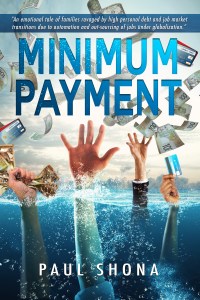
Announcing the release of second fiction

I am pleased to inform my readers/visitors that my third book – or the second fiction – titled

Minimum Payment

is now available at amazon.com as well as at Kindle, Barnes & Nobles, i-Books, and other retail outlets selling e-books.

The digital version is priced at US$2.99 and the print at $14.95. The book should soon be available at different international outlets of Amazon.com including that in Canada, the United Kingdom, India, Australia, and New Zealand, in their respective currencies.

Like my previous books, I have written this fiction under pseudonym ‘Paul Shona’.

Blurb:

A heart-touching tale of families ravaged by rising personal debt and changes in the labour market due to rapidly growing automation, computer and digital technology on one hand, and international trade agreements facilitating out-sourcing of jobs from high to low-wage countries, on the other.

You are welcome to place your order with the author at rajchawla6@yahoo.ca.

Transcript of my interview at Authors Show

On October 5, 2017, I was interviewed at the Authors Show on my book “A Writer’s Journey Through the Bureaucratic Maze: A True Account.” This interview will be re-broadcast on October 30th and November 6th.

I am pleased to place the transcript of this interview.

Update, September 16, 2017

The digital version of my book – A Writer’s Journey Through the Bureaucratic Maze: A True Account – is now available at Apple’s iBooks, Kobo, Barnes & Noble, Inktera, Playster, Scribd, Tolino, and 24 Symbols.

Article from the ORLÉANS COMMUNITY NEWS, August 3, 2017

I am pleased to share with you all an article from the ORLÉANS COMMUNITY NEWS containing a short review of my latest book “A Writer’s Journey Through the Bureaucratic Maze: A True Account” as well as a brief reference to my debut romance fiction “Quest for Second Sex“. I sincerely thank the journalists – Brier Dodge and Nevil Hunt – for their kind words.

I may add here that both books are available in a downloadable Kindle edition – each at $2.99. The print versions are available at amazon.com at $14.95 and $21.99 respectively.

Both of my books are now available at Ottawa Public Library (OPL) and its branches.

I look forward to receiving your comments and/or reviews. Please mail these at rajchawla6@yahoo.ca.

Scanned at 04-08-2017 15-12 PM

Release of my second book – a non-fiction

I am pleased to announce the release of my second book – a non-fiction – titled A Writer’s Journey Through the Bureaucratic Maze: A True Account. Both its digital and print versions are now available at amazon.com (US$) and/or amazon.ca (C$). You can buy e-version at US$2.99/C$4.03, and print at $14.95/$20.19.

Blurb:

It’s a personal account of obstacles and challenges, I, as a writer, experienced during my journey lasting over four decades in the bureaucracy. During all of my professional life, I swam against the chin-high tidal waves and survived because of my inner strength. A must read tale of patience, persistence, and perseverance – the essential characteristics a writer needs to succeed.

URL for my books:

https://www.amazon.com/author/paulshona

Announcement

Please note that I will not be placing any new post on the site in the next 4-5 months as I am now focused on completing my next fiction entitled Minimum Payment. I will post the abstract of this fiction after completing its first draft – hopefully by the middle of October 2017. I am hoping to have it released by late December.

My non-fiction “A Writer’s Journey Through the Bureaucratic Maze: A True Account” was released in early June.

Thanks for visiting the site and your support and understanding.

Please feel free to contact me by leaving a message at the site, or by e-mailing me at rajchawla6@yahoo.ca.